What is a Statement of Purpose and why is it required?
A Statement of Purpose is the part of your graduate school application where you explain, in your own words, why you want to study a specific subject at a specific program — and why you're ready to do so.
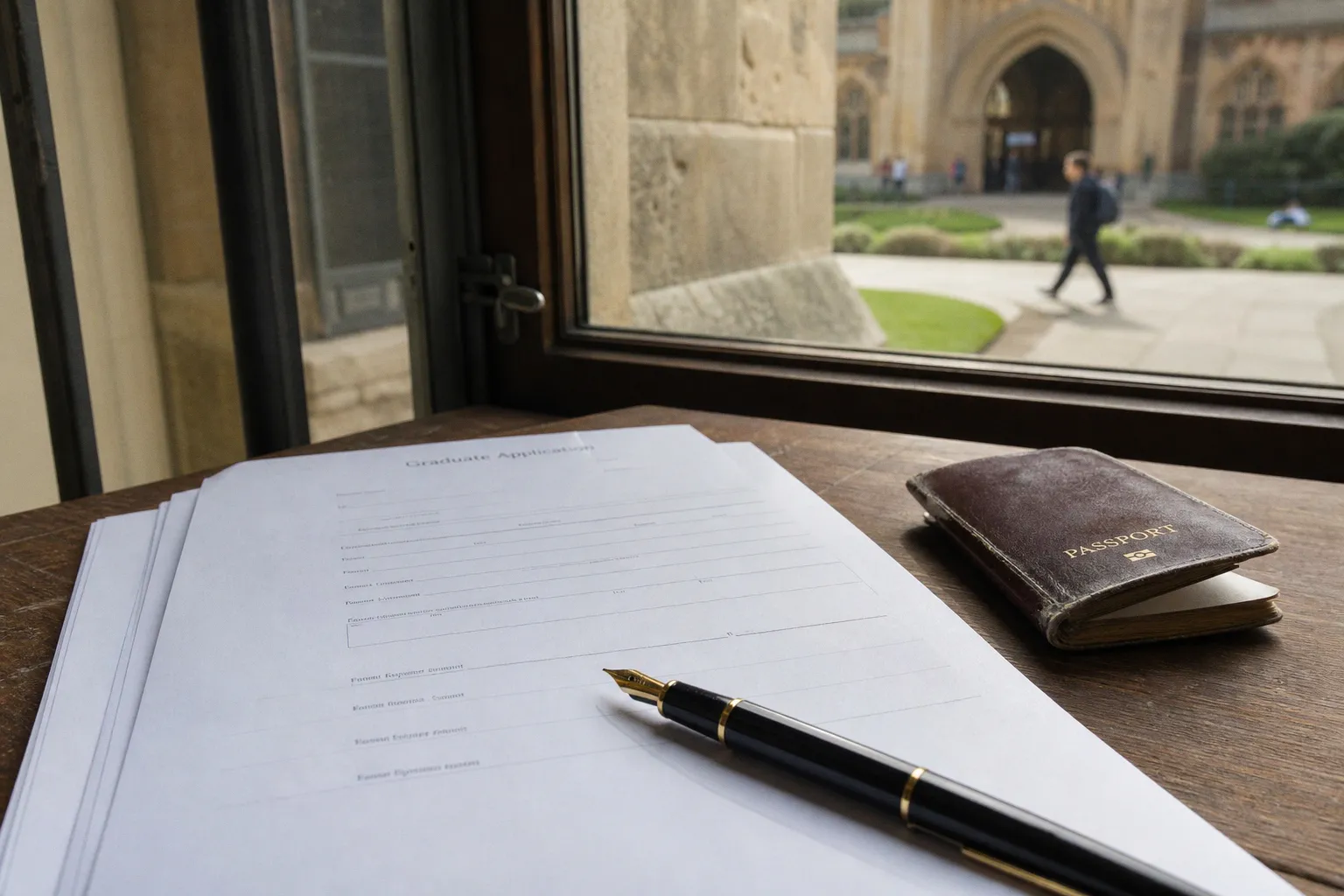
It sits alongside your transcripts, your test scores, your letters of recommendation, and your resume, and it does something none of those documents can: it gives the admissions committee a sense of how you think and what drives you.
If you've been searching "what is statement of purpose" because you're staring at an application portal that says "Upload SOP" and you have no idea what belongs in that file, you're in the right place. We'll walk through what an SOP actually is, why universities ask for one, how it differs from a personal statement, what length and formatting reviewers typically expect, and how to shape your draft around the prompt your program has actually given you.
What an SOP Actually Is, and Why Programs Ask for One
At its core, a Statement of Purpose is a program-specific essay that explains your academic preparation, your research or professional interests, your goals, and your fit with the department you're applying to. It's the essay where an admissions reader looks for the answer to a deceptively simple question: should we admit this person, and if so, what kind of contribution are they likely to make here?
Different schools use different labels. Some call it the Statement of Purpose. Some call it the Academic Statement of Purpose. Some use the broader phrase "personal statement" to refer to the same document. The terminology is not perfectly standardized across institutions, which is why it's worth checking your program's specific instructions before you start drafting.
In practical terms, think of the SOP as a written introduction that the committee can't get anywhere else. Your transcript tells them what courses you've taken. Your CV tells them where you've worked. Your recommenders tell them how others see you. The SOP is where you put the whole story together in your own voice and on your own terms.
An SOP is your chance to show the committee not just what you've done, but how you think and where you're headed — and to do it in the way only you can.
Admissions committees don't ask for an SOP to make your life harder. They ask for it because the other pieces of an application — grades, test scores, a list of publications — can't tell them what they actually need to know. Those numbers describe the past. The SOP describes the trajectory.
Essentially, the committee wants to know three things when they read your SOP:
1. Do you understand what this field is and what studying it here actually involves?
2. Have you done enough relevant work to handle the program's rigor?
3. Is there a believable path between where you are now and where you say you want to go?
If you can answer those three questions clearly, with evidence from your own experience, you're doing what the SOP is designed to do. If your draft reads like a generic essay that could be sent to any program, that's usually the first sign something's off.
Keep in mind that graduate programs are looking for a match, not just a strong candidate. A brilliant applicant who wants to study something the department doesn't offer is not a fit. A slightly less experienced applicant whose research interests align with three faculty members' current work is often a much stronger candidate. The SOP is where that fit gets demonstrated or fails to get demonstrated, which is why the essay matters as much as it does.
SOP vs Personal Statement: What's the Difference?
This is one of the most common points of confusion, and it's worth handling carefully. Many applicants assume that "statement of purpose" and "personal statement" mean exactly the same thing. They often overlap, but they are not always the same document, and treating them as interchangeable can lead you to write an essay that misses what the program is actually asking for.
ETS, the organization behind several major standardized tests, has pointed out that schools sometimes use the two terms interchangeably — and sometimes don't. The general distinction that holds up across most institutions looks like this:
| Document | Primary focus | What it centers on |
|---|---|---|
| Statement of Purpose | Academic and professional direction | Your preparation, research interests, goals, and fit with the program |
| Personal Statement | Personal background and identity | Who you are, what shaped you, and how your perspective contributes to the field |
In other words, an SOP leans academic. A personal statement leans biographical. Some programs ask for one. Some ask for both. A few programs ask for what is essentially a hybrid, and they may not be precise about which is which.
If your program asks for a "Statement of Purpose" or "Academic Statement of Purpose," write an academically focused essay. If it asks for a "Personal Statement," lean into your background. If it asks for both, don't submit the same essay twice with a few paragraphs swapped — that's a fast way to make it obvious you treated the application as a checkbox.
A quick scenario
If-then: If the prompt asks why you want to study computer science at this specific university, your SOP should talk about your preparation in algorithms, your undergraduate thesis on distributed systems, and the two faculty members whose work you'd like to build on. Then: your personal statement, if one is required, is where you talk about growing up in a household where you built your first computer out of spare parts, and how that shaped the curiosity you now bring to research. Same applicant, two different essays, two different jobs to do.
Length and Formatting: What Reviewers Expect
There's no single global rule about how long an SOP should be. Different programs set different limits, and the most common pattern across U.S. graduate programs is something in the range of one to two pages, or roughly 500 to 1,000 words. Some programs go longer, some shorter, and a few specify a page count instead of a word count.
For a sense of the range, here's what a few well-known programs typically expect:
| Institution | Typical SOP guidance |
|---|---|
| Stanford Graduate Admissions | Around 1,000 words recommended for the central prompt, with the caveat that programs may set their own length |
| UC Berkeley Graduate Division | Approximately 500–1,000 words, or 1–2 single-spaced pages in 12-point font, unless a program says otherwise |
| Cornell Graduate School | One to two pages in a standard font and size is typical, unless otherwise noted |
| MIT EECS Communication Lab | No more than two pages is the usual expectation |
| Arizona State University | Around 1–2 pages for many programs |
Notice how the numbers cluster. One to two pages, somewhere between 500 and 1,000 words, is the working range for the majority of U.S. graduate programs. That doesn't mean it's a universal rule, and it definitely doesn't mean you should ignore a specific program's instructions. Always check.
Formatting is generally straightforward: a standard 11- or 12-point font, single or 1.5 spacing, one-inch margins, and your name and the program name somewhere on the document. Some schools have their own templates; if yours does, use it. The formatting doesn't need to be creative. The content does.
How to Align Your Story with the Program's Prompt
Here's the part that makes the biggest practical difference, and it's where many otherwise strong applicants lose points without realizing it. Most programs publish a prompt, and that prompt is doing real work. It tells you exactly what the committee wants to read about, in roughly what order, with what emphasis. Writing to that prompt — rather than around it — is half the job.
Take Stanford's central prompt as one example. It asks applicants to explain their reasons for applying, their preparation for the field, their research interests, their future career plans, and any other background that helps the committee evaluate aptitude and motivation. If your draft doesn't address each of those elements somewhere in the essay, you're not answering the question.
UC Berkeley's graduate prompt is similar in spirit: address your aptitude and motivation for graduate study, your preparation, your academic plans or research interests, your future career goals, and why Berkeley is an intellectual fit for you. Cornell frames its academic statement as a way to help the committee understand your academic objectives and assess whether you're a good match for the program.
A useful way to think about this is in three layers:
- Layer 1: Your past. What have you studied, researched, written, built, or worked on that prepared you for this field? Be specific. Name a course, a project, a paper, a role.
- Layer 2: Your present. What do you actually want to study here, and why? Which faculty, which labs, which kinds of questions? This is where fit gets demonstrated.
- Layer 3: Your future. What do you plan to do with the training this program will give you, and how does that connect back to the work the program does?
If those three layers are present and clearly connected, you'll have written an SOP that answers the prompt. If they're not, the essay will feel scattered, no matter how elegant the prose is.
If you're applying to more than one program
If-then: If you're applying to five programs with similar prompts, it's tempting to write one master SOP and ship it everywhere. Then: you'll likely end up with a draft that fits no one well. The cleaner approach is to write a strong base essay, then adjust the second and third layers — the present and the future, the fit — for each program. The bones stay the same; the details change. That alone is often the difference between an SOP that reads as thoughtful and one that reads as recycled.
Pacing Yourself Through the Writing
Here's something worth saying out loud: writing an SOP is mentally taxing work, and most applicants underestimate how long it takes to produce a draft they're genuinely happy with. Give yourself a buffer. A realistic schedule usually looks something like this:
- Two to three weeks before any deadline to outline your narrative and gather your evidence
- One to two weeks to write a full first draft
- Another week to revise, get feedback from a trusted reader, and tighten
- A few final days to format, proofread carefully, and submit
If you're applying to several programs with similar but not identical prompts, plan for more time, not less. And if you've been staring at the same paragraph for hours, step away. The way athletes think about pacing and recovery between training sessions is closer to good writing practice than most people realize — for a look at how that debate actually plays out, the question of hot versus cold therapy for muscle recovery gets at a similar principle: rest is part of the work, not a break from it.
A few practical questions tend to come up at this stage, and answering them honestly tends to save you a lot of wasted effort. Do you need an SOP for every application? No — some programs, especially at the undergraduate level or in certain professional fields, don't ask for one. Can you reuse the same SOP for multiple programs? You can reuse the foundation, but you should not send an identical final version to programs with different prompts; the committee can tell. Does the SOP matter more than your grades or test scores? No single document overrides the rest of your application. Think of the SOP as the part that ties the rest together, not the part that saves it.
The SOP is not the most important part of your application — but it's the part only you can write, and that's why it carries real weight.
Final Thoughts
The Statement of Purpose is a program-specific essay that explains why you want to study what you want to study, why you're prepared to do it, and why this particular program is the right place to do it. It is not a generic autobiography, and it is not a place to repeat your resume in paragraph form. It is a structured, evidence-backed argument for why the committee should invest in you.
If you remember nothing else, keep this in mind: read the prompt, write to the prompt, and let your own preparation and curiosity do the heavy lifting. A clear, specific, honest SOP will outperform a beautifully polished generic one almost every time — and that's the kind of peace of mind you actually want as you navigate the rest of your application.