IELTS preparation course selection: a step-by-step guide
Most IELTS course selection errors start with the same flawed assumption: any structured English course can optimize an IELTS score. It cannot. IELTS is not a generic language exam.
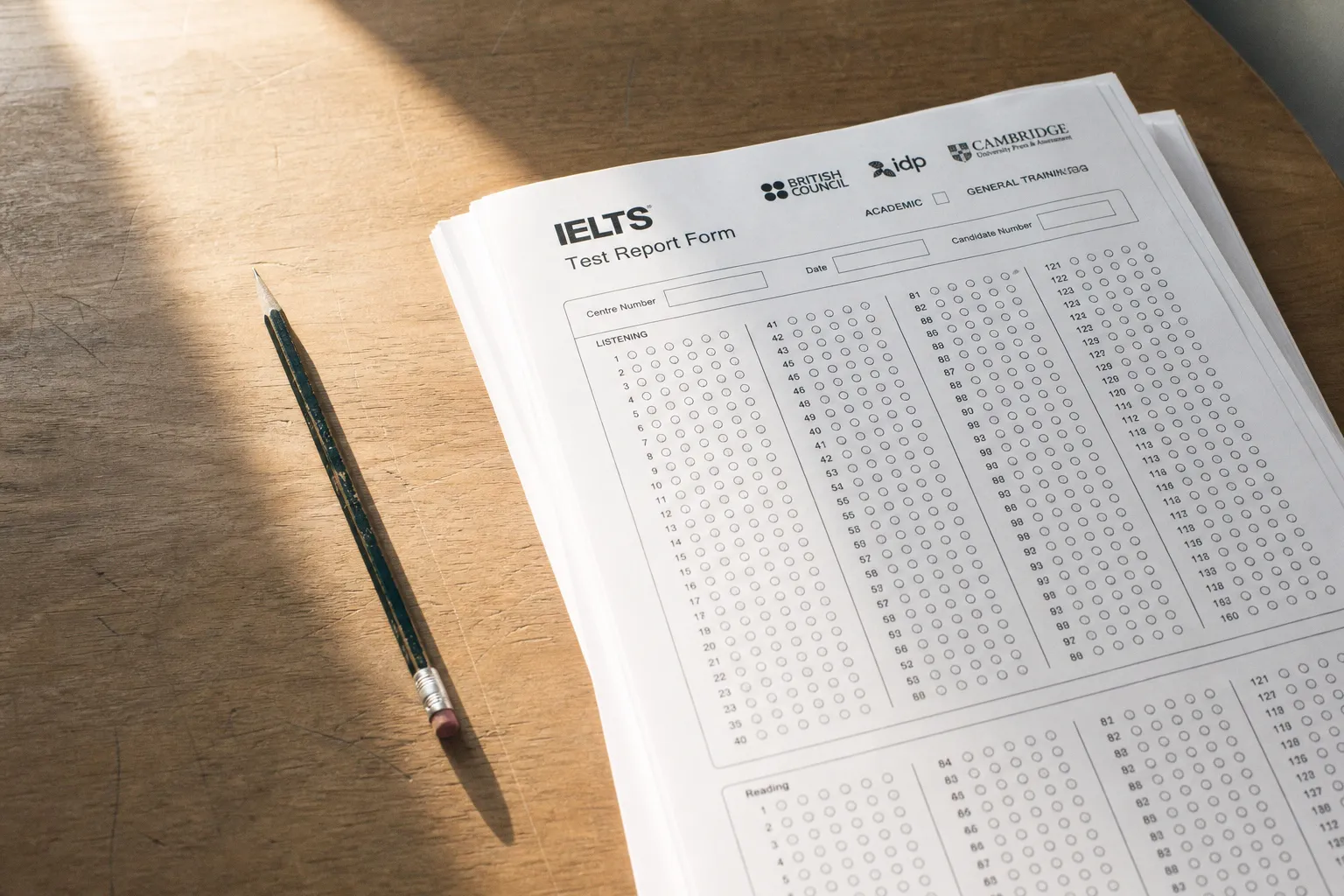
For university admissions, the margin is narrow. Many institutions set IELTS thresholds between 6.0 and 7.5 for undergraduate and postgraduate entry. A candidate at 6.0 who needs 7.0 is not “almost there” in operational terms. That candidate has a measurable gap in task control, accuracy, fluency, or academic reading efficiency. The right IELTS preparation course identifies that gap early. The wrong one adds hours without changing the metric.
Step 1: Define the target before comparing courses
An IELTS preparation course should not be selected before the candidate defines three variables:
1. Target test version
2. Required band score
3. Current baseline score
This sounds basic. It is where many candidates lose time.
IELTS has two main versions: Academic and General Training. The Academic test is the standard route for university admissions. General Training is usually used for migration, employment, or some secondary education pathways. A course that mixes both tracks without clear separation is structurally weak for an admissions candidate.
The difference is not cosmetic. Listening and Speaking follow the same format across both versions, but Reading and Writing differ in purpose and task design. Academic Writing requires candidates to describe visual information in Task 1 and produce an essay in Task 2. General Training Writing includes a letter in Task 1. Reading texts also differ in density and source style.
For an applicant using IELTS as part of a university file, the course must be mapped to the Academic module unless the institution explicitly states otherwise.
| Decision point | Academic IELTS | General Training IELTS |
|---|---|---|
| Primary use case | University admissions, professional registration | Migration, work, some non-degree routes |
| Writing Task 1 | Chart, graph, table, map, process description | Letter |
| Reading style | Academic and semi-academic texts | Workplace, social, general-interest texts |
| Best course fit | Academic task analysis and university score targets | Practical communication and migration-oriented tasks |
| Admissions relevance | High | Usually low for degree entry |
The second variable is the target band. “A good score” is not a usable planning metric. A 6.5 overall with no band below 6.0 may satisfy one program. Another may require 7.0 overall and 7.0 in Writing. The course has to prepare against the actual threshold, not a general ambition.
The third variable is the baseline. A candidate should not buy a 12-week advanced course because the marketing page says “Band 7+.” The baseline diagnostic must show whether that target is statistically plausible within the available preparation window.
Course selection starts with the admissions threshold, not the course brochure.
For applicants managing several admissions requirements at once, IELTS is only one document in the sequence. Test dates, transcript deadlines, CAS or admission letters, and immigration steps can collide. Candidates planning UK study should keep the visa stage visible early, including the process to submit a UK student visa application online, because late English-test completion can compress the entire timeline.
Step 2: Match the syllabus to the IELTS exam structure
The IELTS exam has four sections:
- Listening: 30 minutes
- Reading: 60 minutes
- Writing: 60 minutes
- Speaking: 11–14 minutes
The total test time is approximately 2 hours and 45 minutes. A course that does not allocate time in proportion to this structure is not optimized for IELTS performance.
A credible IELTS course syllabus should show coverage of all four sections, but equal coverage is not always correct. The candidate’s diagnostic profile should determine weighting. A student with strong spoken fluency and weak Academic Writing Task 1 does not need the same plan as a student who loses marks through listening distractors and slow reading speed.
Still, the syllabus needs minimum structural integrity. It should cover the following.
Listening
The Listening module tests more than hearing. It tests prediction, spelling control, attention under sequence pressure, and the ability to avoid distractors. Strong courses train candidates to:
- read questions before the audio starts;
- identify word-limit instructions;
- track paraphrase rather than wait for identical wording;
- distinguish corrected answers from first-mentioned answers;
- transfer answers accurately.
Weak courses treat listening as passive exposure. That is inefficient. Candidates need controlled practice under exam timing, followed by error classification. A wrong answer caused by spelling is different from a wrong answer caused by losing the audio thread.
Reading
Reading is where many Academic IELTS candidates underestimate the clock. Sixty minutes for three passages leaves little room for slow translation, repeated rereading, or unplanned answer transfer. A good course trains:
- skimming for text architecture;
- scanning for names, dates, definitions, and comparative terms;
- matching headings by function, not keywords alone;
- handling True/False/Not Given without inference drift;
- managing passage difficulty order.
The course should also teach candidates how to abandon low-yield questions temporarily. Spending six minutes on one difficult item is a scoring error, not persistence.
Writing
Writing usually requires the most precise feedback. It is also the section where generic English classes fail most often.
Academic Writing Task 1 requires data selection, overview construction, comparison, and accurate description of trends or processes. It is not a place for opinions. Task 2 requires position control, paragraph logic, relevant examples, grammar range, and lexical precision.
A course that gives only model essays is insufficient. A course that marks only grammar is also insufficient. The scoring metric includes task response or task achievement, coherence and cohesion, lexical resource, and grammatical range and accuracy. The feedback must address all relevant dimensions.
Speaking
Speaking takes 11–14 minutes, but it can affect admissions outcomes if a program sets minimum sub-scores. The format tests fluency, coherence, lexical resource, grammar, and pronunciation under live interaction.
The course should include recorded or live speaking practice. Text-only speaking advice has limited value. Candidates need timing, follow-up questions, correction of repeated errors, and exposure to Part 2 long-turn pressure.
Step 3: Require a diagnostic test before enrollment or in week one
A diagnostic test is not an optional feature. It is the baseline measurement. Without it, an IELTS online preparation program or classroom course cannot allocate effort rationally.
The diagnostic should not be a five-minute placement quiz. It should approximate IELTS task types across the four sections, with enough writing and speaking evidence to identify score-limiting weaknesses. Multiple-choice grammar tests are not enough.
A useful diagnostic produces a profile like this:
| Skill area | Baseline evidence | Operational meaning | Course response |
|---|---|---|---|
| Listening | Frequent errors in section 3 distractors | Candidate follows topic but misses correction signals | Targeted distractor drills and prediction practice |
| Reading | Slow completion of passage 3 | Vocabulary and scanning speed below threshold | Timed passage strategy and question-type sequencing |
| Writing Task 1 | No clear overview | Task achievement ceiling likely limited | Overview construction drills and data grouping |
| Writing Task 2 | Ideas relevant but weak paragraph control | Coherence risk | Paragraph planning and thesis-control practice |
| Speaking | Fluent but repetitive vocabulary | Lexical resource constraint | Topic-range expansion and recording review |
This is the point where claims about “fast band improvement” should be treated carefully. There is no standardized public pass-rate metric for private IELTS courses, and third-party success statistics are not regulated in the same way official exam data is. A provider may have strong teaching. It may also have selective reporting. The candidate should evaluate method, not marketing yield.
A course without a diagnostic is not a course plan. It is a timetable.
The baseline also prevents overbuying. A candidate already scoring 7.5 in Reading does not need extensive basic reading lessons. The constraint may be Writing 6.0. In that case, the optimal course is not the largest package. It is the one with the densest expert feedback on writing.
Step 4: Evaluate feedback quality, not lesson volume
Lesson count is a weak metric. Feedback quality is a stronger one.
An IELTS course can offer 60 hours of instruction and still underperform if candidates do not receive specific correction. Conversely, a shorter course with rigorous writing marking, recorded speaking analysis, and timed mock tests may produce better preparation efficiency.
The course should specify how feedback works. Look for operational detail:
- Writing correction frequency: How many full Task 1 and Task 2 responses are marked?
- Feedback depth: Are comments linked to IELTS criteria or just grammar notes?
- Turnaround time: Can the candidate revise while the task is still fresh?
- Speaking review: Are sessions recorded or scored against band descriptors?
- Error tracking: Does the course identify repeated weaknesses over time?
- Tutor qualification: Does the instructor understand IELTS scoring, not just general ESL teaching?
For Writing, the minimum viable system includes marked assignments with comments on task achievement, coherence, vocabulary, and grammar. A one-line score estimate is not enough. The candidate needs to know why the response is capped.
For Speaking, the course should include live or recorded interaction. Pronunciation cannot be optimized through written worksheets alone. Fluency issues also require real-time pressure. A student who performs well in self-practice may collapse under follow-up questioning. That discrepancy must be measured before test day.
The feedback test: one sample assignment
Before paying for a long course, a candidate should examine a sample marked writing task if available. The sample should show whether the provider can diagnose at band-level granularity.
Weak feedback looks like this:
- “Use better vocabulary.”
- “Improve grammar.”
- “Add examples.”
- “Good essay, aim higher.”
Useful feedback looks like this:
- “The position is clear in paragraph 1 but becomes inconsistent in paragraph 3.”
- “The overview in Task 1 reports figures but does not identify the main trend.”
- “Cohesion depends too much on mechanical linking words.”
- “Sentence control drops in complex clauses, which creates accuracy risk.”
The difference is material. IELTS scoring is criterion-based. Feedback must be criterion-aware.
Step 5: Check whether materials are authentic and current
Official IELTS preparation materials are provided by the test partners: British Council, IDP: IELTS Australia, and Cambridge University Press & Assessment. A private IELTS preparation course does not need to use only official materials, but it should integrate materials that accurately reflect the exam structure and task demands.
The risk is not that unofficial materials exist. Many are useful. The risk is distortion. Some courses overuse simplified passages, recycled speaking topics, or writing prompts that do not match the density of the actual Academic test. That creates a false baseline.
A good course makes a clear distinction between:
1. Skill-building materials
Used to develop grammar, vocabulary, listening discrimination, or reading speed.
2. IELTS-style practice materials
Used to train task types and exam strategies.
3. Official or official-standard mock tests
Used to measure readiness under realistic conditions.
These categories should not be blurred. A vocabulary worksheet may support preparation, but it is not evidence of band readiness. A classroom discussion may improve fluency, but it is not a Speaking test simulation.
For 2026 candidates, current format alignment matters more than decorative platform features. A polished dashboard does not compensate for inaccurate task design. When choosing an IELTS course, the candidate should inspect actual lesson samples, not only testimonials.
Step 6: Demand full mock tests under exam conditions
Mock tests are not just practice. They are stress tests of timing, concentration, and scoring stability.
A reputable course should include mock tests that simulate the actual exam environment. That means timed Listening, timed Reading, timed Writing, and realistic Speaking practice. The purpose is to identify whether the candidate can reproduce performance under pressure.
Partial practice produces inflated confidence. A student may complete Reading Passage 1 accurately in isolation, then fail to finish Passage 3 when the full 60-minute constraint is applied. A student may write a strong Task 2 in 50 minutes at home, then lose structure after completing Task 1 first under exam timing.
The mock test should measure at least four outputs:
| Mock-test output | Why it matters |
|---|---|
| Overall band estimate | Indicates admission-level readiness |
| Section scores | Shows whether minimum sub-score thresholds are at risk |
| Timing record | Identifies inefficient task sequencing |
| Error pattern | Directs the final study cycle |
The strongest courses do not simply administer mocks. They debrief them. The debrief is where score improvement becomes possible. Candidates need to know which errors are random and which are systematic.
Systematic errors include:
- repeated spelling mistakes in Listening;
- misclassification of Not Given statements in Reading;
- missing overview in Writing Task 1;
- unsupported claims in Writing Task 2;
- short, underdeveloped answers in Speaking Part 3.
Random errors can be reduced through attention and repetition. Systematic errors require instruction.
Step 7: Choose the format that fits the constraint
IELTS online preparation is not automatically weaker than in-person training. In some cases, it is better. The relevant metric is not delivery format. It is whether the format supports feedback, timing discipline, and completion.
Online courses have clear advantages:
- flexible scheduling across time zones;
- recorded lessons for review;
- easier access to specialist tutors;
- digital writing submission and tracked correction;
- lower commuting cost.
In-person courses have different advantages:
- fixed attendance structure;
- live peer interaction;
- immediate classroom control;
- easier speaking practice for some candidates;
- reduced self-management burden.
The candidate should choose based on constraint, not preference alone. A working applicant with limited travel time may perform better in a structured online course. A student with weak self-discipline may need the external pressure of a classroom.
Hybrid models can work if they are not vague. “Hybrid” should mean something measurable: live speaking sessions plus asynchronous writing correction, or classroom instruction plus online mock testing. If the provider cannot define the learning architecture, the label has no value.
Group class, private tutor, or self-paced course
The market usually offers three models. Each has a use case.
| Course model | Best fit | Main limitation |
|---|---|---|
| Group class | Candidates near the target band who need structure and broad task coverage | Feedback may be limited |
| Private tutor | Candidates with a specific bottleneck, usually Writing or Speaking | Cost can be high |
| Self-paced course | Candidates with strong discipline and a clear baseline | Weak for speaking and individualized correction |
A candidate below the target by more than one band in Writing should be cautious with self-paced-only preparation. Writing improvement requires correction. Reading and Listening can improve substantially through disciplined independent practice, but Writing has a high blind-spot risk.
Step 8: Build the study plan around the score gap
A course is not a substitute for an IELTS study plan. It is one component. The candidate still needs a weekly structure that converts lessons into measurable output.
The most efficient IELTS study plan steps are sequential:
1. Measure the baseline.
Complete a diagnostic test across all four sections before setting the weekly workload.
2. Identify the limiting section.
The lowest sub-score is not always the only problem. A university may impose minimum band requirements, so a single weak section can block admission.
3. Allocate time by score gap.
Do not divide study hours equally if the score gaps are unequal. A candidate at Reading 7.5 and Writing 6.0 should prioritize Writing.
4. Train task types separately.
Practice Listening maps, Reading headings, Writing Task 1 overviews, and Speaking Part 3 explanations as distinct units before full mocks.
5. Run timed sets weekly.
Untimed practice builds familiarity. Timed practice builds exam readiness. Both are needed, but timed work must increase as the test date approaches.
6. Review errors in categories.
Track whether errors are caused by vocabulary, grammar, timing, misunderstanding instructions, or weak task strategy.
7. Complete full mock tests.
Use full simulations to verify score stability. One strong section score in isolation is not sufficient.
This plan should be visible inside the course. If the provider cannot explain how a candidate moves from baseline to target, the course is not strategy-led.
Common selection errors that reduce score efficiency
IELTS preparation becomes inefficient when candidates buy surface features instead of measurable support. The most common errors are predictable.
Error 1: Selecting by advertised band promise
No private course can credibly guarantee a specific band increase for every candidate. Improvement depends on baseline proficiency, study time, feedback quality, and test execution. A provider can offer a method. It cannot override language acquisition limits.
Error 2: Ignoring sub-score requirements
An overall score can hide a weak section. A candidate may reach 7.0 overall with Writing 6.0. If the university requires 6.5 or 7.0 in each band, the application still fails the English threshold. Course selection must account for section-level requirements.
Error 3: Treating Writing as memorization
Memorized templates create risk. IELTS Writing rewards task response, coherence, lexical resource, and grammar control. A rigid template can produce irrelevant essays, mechanical cohesion, and unnatural phrasing. Frameworks are useful. Full memorized answers are not.
Error 4: Taking mocks without analysis
Mock tests without debriefs are score reports, not preparation. The candidate needs a correction loop. Otherwise the same mistakes repeat under slightly different prompts.
Error 5: Using General Training materials for Academic admission
This error is basic but common. Academic candidates need Academic Reading and Academic Writing Task 1. General Training practice does not adequately simulate the admissions test route.
The final selection standard
The right IELTS preparation course is not the one with the broadest promise. It is the one that connects five elements with minimal noise:
- the candidate’s required IELTS version;
- the target overall and section band scores;
- a diagnostic baseline;
- a syllabus mapped to Listening, Reading, Writing, and Speaking;
- mock testing with criterion-based feedback.
For admissions candidates, the decision should be clinical. If a course cannot show how it diagnoses, teaches, measures, and corrects, it is not optimized for the IELTS score threshold. It may still teach English. That is a different objective.
IELTS preparation is a scoring project constrained by time. Select the course that treats it that way.