Free IELTS preparation tests: how to spot inaccurate mocks
Free IELTS preparation tests can save you money. They can also quietly sabotage your score if you practice with the wrong ones for six weeks and walk into the real exam trained on bad logic, loose…
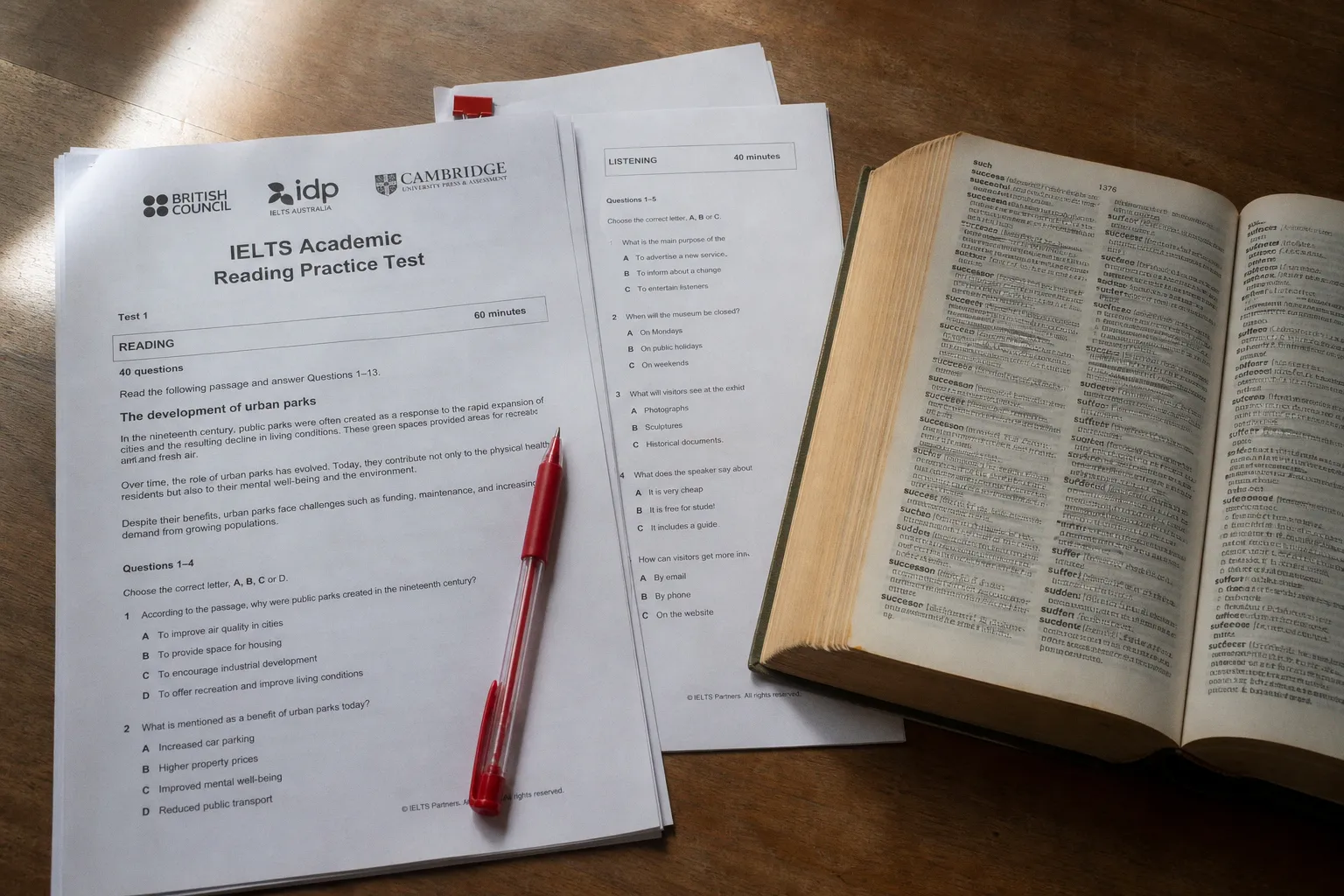
Free IELTS preparation tests can save you money. They can also quietly sabotage your score if you practice with the wrong ones for six weeks and walk into the real exam trained on bad logic, loose timing, and fantasy band scores.
That is the part many candidates miss. A free IELTS mock is not automatically useful because it looks like IELTS. The exam has a specific architecture: task types, timing, scoring conversion, word limits, distractor logic, and assessment criteria. When a website ignores those rules, you do not get “extra practice.” You get distorted feedback. And distorted feedback is expensive, even when the test itself costs nothing.
The bottom line: a free mock test is only valuable if it trains the same skills the real IELTS exam measures.
Start with source quality, not with the word “free”
The safest free IELTS preparation tests come from the test owners and their official publishing ecosystem: British Council, IDP: IELTS Australia, and Cambridge University Press & Assessment. That does not mean every other resource is useless. It does mean third-party platforms start with a burden of proof.
We see candidates make the same bad bargain every cycle: they choose the platform that gives instant scores, colorful dashboards, and a confident “Band 7.5” prediction. Then their real Listening or Reading result lands a full band lower, or their Writing score refuses to move. The problem was not always effort. Often, they were measuring themselves with a bent ruler.
Here is the practical distinction:
| Resource type | What it can do well | Where it can mislead you |
|---|---|---|
| Official IELTS materials | Match real task formats, timing, and scoring principles closely | Limited quantity; may not explain every mistake in depth |
| Cambridge IELTS practice books | Strong exam alignment and authentic practice value | Usually not free; answer explanations can be brief |
| University or school prep pages | Useful for strategy, vocabulary, sample lessons | Practice tests may be simplified or old |
| Third-party free mock sites | Convenient volume and instant practice | Non-standard questions, invented scoring, weak Writing/Speaking feedback |
| AI-scored practice tools | Fast feedback and pattern spotting | Cannot give an official band score; may reward polished language over IELTS criteria |
A platform does not need to be official to help you drill grammar, build vocabulary, or practice timing. But if it claims to give an “IELTS mock test free with band score,” slow down. For Reading and Listening, a rough conversion is possible because answers are objectively right or wrong. For Writing and Speaking, any exact band prediction from an unofficial tool deserves skepticism.
Not panic. Skepticism.
That is how you protect your return on investment: time, test fees, application deadlines, visa timelines, and scholarship windows.
What a reliable IELTS Reading and Listening mock must get right
IELTS Academic Reading and Listening each contain 40 questions. Each correct answer is worth one mark, and the raw score is converted to the IELTS 0–9 band scale. That basic structure matters. If a mock test gives you 32 questions, or 45, or a vague “advanced” label instead of a score, it is not simulating the exam. It may still be useful as English practice. It is not a reliable IELTS mock.
For Academic Reading, expect 60 minutes total. Not 75. Not “take your time and check later.” The pressure is part of the test. A free IELTS Academic Reading practice test that lets you drift through passages without a hard clock gives you a false sense of control. The real exam punishes slow reading, overchecking, and perfectionism.
For Listening, the structure must also feel like IELTS: recordings played under exam-like conditions, answers captured accurately, and question types that mirror the real test. If the audio quality is poor, accents are cartoonish, or the questions rely on trivia rather than comprehension, the test is training the wrong reflexes.
A reliable Reading or Listening mock should show several signs:
1. It uses the standard 40-question structure. If the section does not have 40 items, do not use its score as a band indicator. Treat it as a drill only.
2. It follows IELTS-style answer rules. Word limits such as “NO MORE THAN TWO WORDS” are not decoration. A mock that accepts sloppy extra words teaches bad habits.
3. It separates practice from prediction. Good resources may estimate a band from raw marks, but they do not pretend that an unofficial score is official.
4. It uses real IELTS question types correctly. Matching headings, sentence completion, summary completion, multiple choice, True/False/Not Given, and Yes/No/Not Given all have specific logic.
5. It forces exam timing. Reading is 60 minutes. Writing is 60 minutes. A platform that removes time pressure removes one of the exam’s main filters.
The scoring issue deserves a blunt note. For Reading and Listening, you can count correct answers. That gives you a raw score out of 40. But band conversion can vary by test difficulty. If a website gives a band score without showing raw marks, answer keys, or any conversion logic, that is a red flag. You are being asked to trust a black box.
And black boxes are bad leverage when your university offer depends on a minimum band.
The Writing trap: generic feedback that feels helpful and changes nothing
Writing is where free IELTS preparation tests most often become dangerous. Not because all free feedback is bad, but because bad feedback is so easy to dress up.
IELTS Academic Writing has two tasks. Task 1 requires at least 150 words. Task 2 requires at least 250 words. The full Writing section lasts 60 minutes. Any mock that ignores those limits is not serious.
Task 2 is especially revealing. If a platform accepts a 180-word essay and still gives cheerful feedback about “good ideas,” it is not assessing IELTS Writing properly. Under-length answers are a major problem. So is feedback that says things like “use more advanced vocabulary” or “improve coherence” without showing where the essay fails.
Real IELTS Writing assessment is not about whether your essay sounds fancy. It looks at task response, coherence and cohesion, lexical resource, and grammatical range and accuracy. A useful mock does not need to replicate an examiner perfectly, but it must engage with those categories. Otherwise you get mood music, not assessment.
Watch for these red flags in Writing feedback:
- No word-count enforcement. If Task 1 under 150 words or Task 2 under 250 words receives a normal score, the tool is too soft.
- Generic praise with no diagnosis. “Strong argument” means little unless the feedback identifies missing development, weak examples, unclear position, or paragraph problems.
- Vocabulary obsession. Many weak tools reward rare words even when they are used unnaturally. IELTS does not pay you for sounding like a thesaurus with a visa appointment.
- No distinction between Task 1 and Task 2. A chart summary and an opinion essay require different skills. A platform that treats them the same is guessing.
- Instant exact bands for complex writing. Fast feedback can be useful, but unofficial tools do not provide official band scores.
A free Writing score that flatters you is worse than no score. It lets the same mistakes survive.
If you want to use a free writing checker, use it narrowly. Ask what it can reliably catch: grammar errors, missing overview in Task 1, paragraph length, repeated vocabulary, sentence fragments, spelling, and word count. Do not treat its band score as a verdict. Treat it as one signal.
The selection-committee view is simple: if your target university needs IELTS 7.0 overall with 6.5 in Writing, you cannot afford fantasy scoring. Writing is often the section that blocks admission conditions and scholarship clearance. Train it with discipline.
The most common unofficial IELTS practice test mistakes
Bad mock tests usually fail in predictable ways. Once you know the pattern, you can spot them quickly.
They confuse True/False/Not Given with Yes/No/Not Given
This is a classic. In IELTS Reading, True/False/Not Given asks whether a statement agrees with factual information in the passage. Yes/No/Not Given asks whether a statement agrees with the writer’s views or claims.
The distinction matters. “False” means the passage contradicts the statement. “Not Given” means the passage does not provide enough information. Many unofficial tests blur this line. They mark an answer “False” because the passage does not mention it. That is wrong. Absence is not contradiction.
Here is the damage: candidates trained on poor tests become too aggressive. They see missing information and mark “False.” On the real exam, that habit costs marks.
A proper item should allow you to prove the answer from the text:
| Question type | Correct logic | Bad mock-test logic |
|---|---|---|
| True | The passage supports the statement | “It sounds generally related” |
| False | The passage directly contradicts the statement | “The passage does not mention it” |
| Not Given | The passage lacks enough information | “I personally think it is unlikely” |
| Yes | The writer’s view agrees with the statement | A fact in the text vaguely matches |
| No | The writer’s view contradicts the statement | The topic is absent |
| Not Given | The writer’s view is not stated | The reader can infer it emotionally |
If a test’s answer explanation cannot point to the exact part of the passage that proves the answer, downgrade the resource.
They write distractors like vocabulary quizzes
IELTS distractors are not random traps. Good distractors test whether you understand meaning, paraphrase, sequence, and qualification. Poor mock tests often create distractors by grabbing similar words from the passage and turning the question into a keyword hunt.
That trains the wrong habit. The real exam often paraphrases the answer. The word you want may not appear in the same form. If every answer in your free mock comes from matching identical phrases, the test is too easy.
A competent IELTS Reading item should make you work through:
- paraphrase rather than exact word matching;
- contrast words such as “however,” “although,” and “whereas”;
- scope limits such as “some,” “most,” “only,” and “in the early stages”;
- chronology, especially in process or research passages;
- writer stance, not just topic recognition.
In Listening, weak distractors show up differently. A speaker may correct themselves: “I thought it was Tuesday, but actually it’s Thursday.” Bad tests ignore that style. Good tests use it. IELTS Listening often checks whether you follow the final confirmed information, not the first thing you hear.
They use non-standard question formats
If a mock includes question types that look invented, be careful. IELTS has a known set of task formats. A site may add creative exercises for learning, and that is fine if labeled clearly. The problem starts when those exercises are sold as full mock tests.
Examples of suspicious design:
- grammar multiple-choice questions placed inside a “Reading test”;
- open-ended comprehension questions that require full-sentence answers;
- opinion questions after a passage;
- Listening questions that require long written explanations;
- Writing prompts with no clear Task 1 or Task 2 format;
- Reading passages much shorter than exam-style academic texts.
Again, the resource may still teach English. But do not call it a mock. Names matter because your preparation strategy changes. A drill improves a sub-skill. A mock tests exam readiness. Confuse those two and you waste time.
How to verify a free IELTS practice test before trusting it
You do not need to audit every website like a forensic accountant. Use a fast filter. If the test fails two or more of these checks, keep it for casual practice at most.
1. Check the source first. Is it from British Council, IDP, Cambridge, or a clearly identified education provider? Anonymous “IELTS experts” with no credentials are not enough.
2. Count the questions. Reading and Listening should each run on the 40-question model if presented as full tests.
3. Check timing. Academic Reading should be 60 minutes. Writing should be 60 minutes. If timing is optional, set it yourself or do not use the result.
4. Inspect the answer explanations. Good explanations show why the correct answer is correct and why tempting alternatives fail. Thin answer keys are less useful.
5. Look at the question types. They should resemble IELTS formats, not general English exercises wearing IELTS clothing.
6. Test the scoring transparency. For Reading and Listening, the platform should show raw marks or enough information to understand the score. For Writing and Speaking, beware of exact unofficial band claims.
7. Check whether materials reflect current delivery. IELTS practice materials are periodically updated as test delivery changes, including computer-delivered IELTS. Old material can still help, but outdated interfaces and instructions may create friction.
8. Compare one sample with official material. If the third-party test feels much easier, shorter, stranger, or more grammar-heavy than official samples, believe the official sample.
This is not about snobbery. It is about calibration. The best free IELTS practice test online is not the one with the slickest dashboard. It is the one that keeps your expectations close to exam reality.
AI-graded IELTS mocks: useful assistant, unreliable judge
AI tools have made IELTS practice more accessible. That is good. A candidate in a city without a strong test-prep center can now get instant corrections, vocabulary suggestions, and fluency prompts. We should not pretend that has no value.
But there is a hard boundary: unofficial AI grading is not official IELTS grading. The exact proprietary algorithms used by private platforms are not public. The specific error rate compared with human IELTS examiners is not something you should assume away. So use AI for leverage, not as a judge.
AI tends to be helpful for:
- spotting repeated grammar errors;
- flagging unclear sentence structure;
- counting words;
- identifying overused linking phrases;
- suggesting simpler wording;
- helping you practice idea generation under time pressure;
- transcribing spoken practice if the audio quality is good.
AI tends to be weaker at:
- judging whether a Task 2 argument is fully developed;
- detecting memorized essay patterns;
- applying IELTS band descriptors consistently;
- evaluating pronunciation in noisy recordings;
- understanding whether examples are relevant enough;
- distinguishing polished language from effective exam writing.
This distinction matters because many candidates chase the wrong upgrade. They try to make their essay sound more “advanced” because a tool praises complex vocabulary. Meanwhile, the essay has no clear position, weak paragraph development, and a conclusion that repeats the question. That is not a vocabulary problem. That is a task response problem.
If you use an AI-scored mock, run it like this: write under real time, enforce the word count, read the feedback, extract two or three specific fixes, and ignore any exact band score unless it is supported by detailed reasoning. Then compare your work with official sample answers and band descriptors where available.
Do not build your admissions plan around an AI prediction. Build it around repeated performance on reliable tests.
A practical system for using free IELTS preparation tests without getting fooled
The smartest candidates do not reject free material. They classify it.
That is the method. Stop asking, “Is this test good?” Ask, “What job can this resource safely do?”
Use official or highly exam-aligned material for full mocks and score calibration. Use third-party free tests for extra drilling only after they pass the basic format checks. Use AI tools for feedback support, not final scoring. Use vocabulary and grammar exercises as supplements, not as substitutes for IELTS tasks.
Here is a clean way to divide your prep week:
| Prep need | Best resource type | How to use it |
|---|---|---|
| Baseline score estimate | Official Reading and Listening practice | Take under timed conditions and record raw marks |
| Reading speed | Exam-style academic passages | Limit time strictly; review wrong answers by question type |
| Listening accuracy | IELTS-format audio practice | Track spelling, plural forms, and corrected information |
| Writing Task 1 | Official prompts and sample answers | Practice overview, comparison language, and 150+ words |
| Writing Task 2 | Timed essay prompts with criteria-based review | Enforce 250+ words and analyze task response |
| Grammar cleanup | Targeted drills or AI feedback | Fix recurring errors after writing, not instead of writing |
| Confidence check | Full mock under exam conditions | Simulate timing, breaks, and computer/paper format as closely as possible |
Do this and you avoid the main trap: confusing activity with progress. Ten random free tests can feel productive and still leave you badly calibrated. Three reliable mocks, reviewed properly, can tell you more.
When reviewing a free mock, do not just record the band estimate. Track the failure pattern:
- Did you lose marks because of vocabulary in the passage?
- Did you misread “Not Given”?
- Did you run out of time?
- Did you change correct answers at the end?
- Did Listening distractors catch you after speaker corrections?
- Did your Writing fall short on word count or paragraph development?
That error log is more valuable than another shiny mock score.
What to do when a free mock gives you a suspiciously high band
If a free site tells you that you are suddenly Band 8 after two weeks, enjoy the dopamine for ten seconds. Then verify it.
Take one official-style Reading or Listening test under strict timing. Count raw marks. Compare the experience. If the free site felt easier, it probably was. If its questions relied on obvious keyword matching, discount the result. If the band appeared without a transparent score breakdown, discount it again.
For Writing, be even tougher. A single high AI score means very little. Submit the same essay to different feedback sources and compare the comments, not the number. If one tool says Band 7.5 and another says your position is unclear, investigate the unclear position. That is the risk.
The admissions world does not reward your best unofficial score. It rewards the score on the test report. For conditional offers, scholarship files, and visa-related timelines, only that result matters.
So keep your system conservative. If you need Band 7.0, train until reliable materials place you above that line with some margin. A candidate repeatedly scoring around the minimum on soft mocks is not safe. One bad Reading passage, one weak Writing prompt, or one nervous Listening section can pull the result down.
The final filter: does the mock make you better at IELTS, or just better at that website?
That is the question I would put above every free IELTS resource.
A useful mock makes the real test feel familiar. The timing feels familiar. The question logic feels familiar. The answer review exposes your actual weaknesses. The score, where appropriate, is transparent and modest about its limits.
A bad mock makes its own platform feel familiar. You learn its shortcuts, its easy patterns, its generous scoring, and its strange question habits. Then the official exam feels like a different animal.
Free IELTS preparation tests are worth using. Just do not give them authority they have not earned. Start with official sources when you need calibration. Treat third-party mocks as tools to be tested, not trusted automatically. Reject fantasy band scores. Protect your prep time like it has a price tag, because it does.
The bottom line is blunt: free practice is only a bargain when it is accurate. Otherwise, it is just a cheaper way to prepare badly.