IELTS preparation test: a step-by-step study routine
The IELTS test occupies a fixed position in the international admissions workflow.
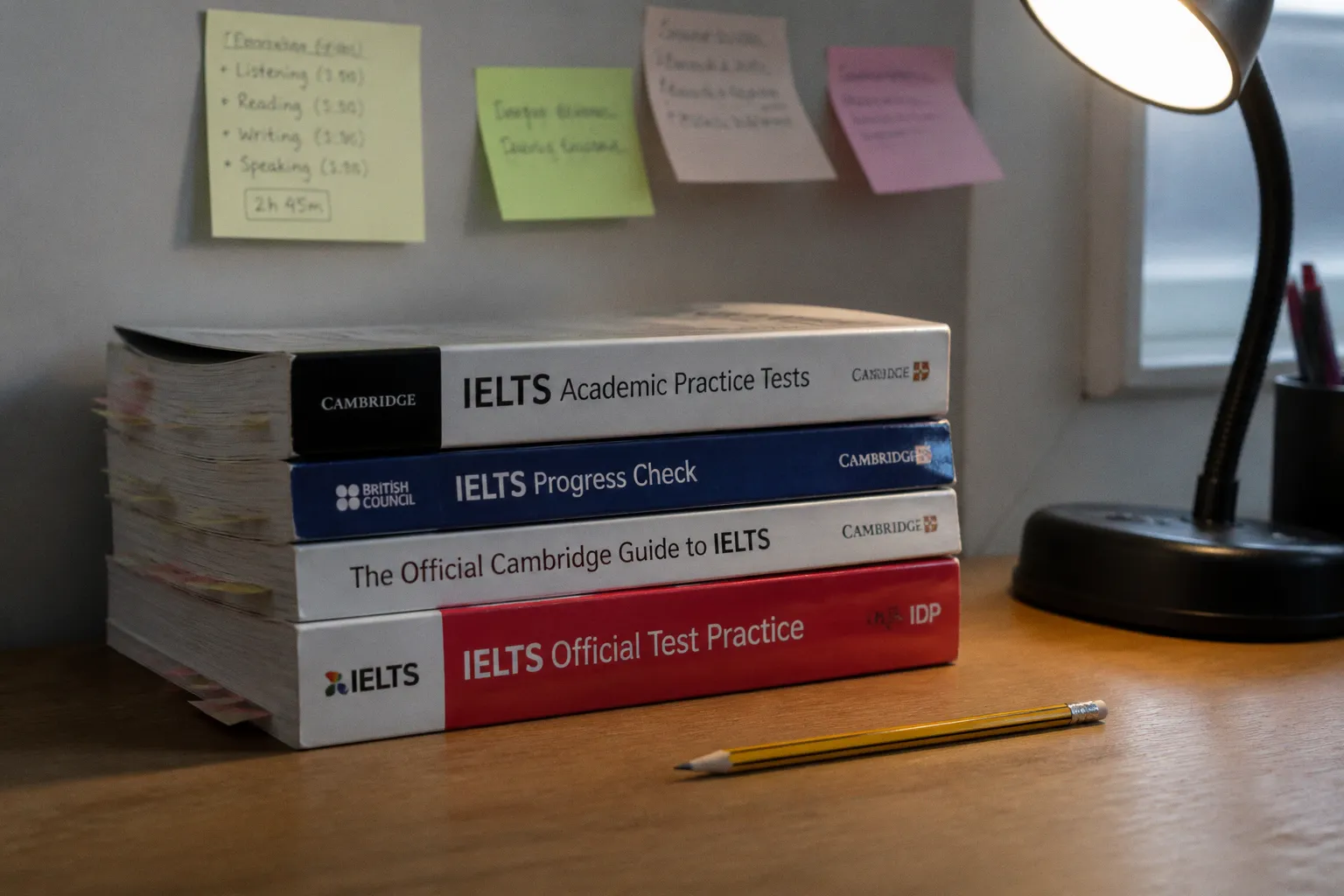
IELTS Preparation Test: a Structured 12-week Study Plan
Twelve weeks of structured daily practice is the standard baseline recommended by the British Council, IDP, and Cambridge; shorter cycles work only for candidates already operating at band 6.5 or above. This guide treats the 12 weeks as an engineering problem. Diagnose. Allocate. Optimize. Measure.
Establishing Your Baseline with Diagnostic Testing
No preparation cycle begins without measurement. Candidates cannot allocate study hours to a skill without first benchmarking it. The diagnostic phase consumes the first 7–10 days of the routine and produces three outputs: a baseline band score per skill, a list of recurring error types, and a calibrated target band.
Three diagnostic instruments are accessible to most candidates:
- IELTS Progress Check. An official online practice test scored by certified examiners; produces a band score per skill and a CEFR-mapped proficiency rating.
- Cambridge IELTS Academic Practice Tests (Books 1–19). Timed, offline, official materials released by Cambridge University Press. Books 17–19 most closely mirror the current test format.
- Free British Council and IDP sample tests. Unscored diagnostic tools designed for format familiarization rather than measurement precision.
A baseline of 5.5 in Reading and 6.5 in Listening, for example, signals a 1.0-band gap in one skill and a 0.5-band gap in another. The 12-week timeline must absorb both. Targets should be set against the specific requirements of the candidate's target institution, not against generic benchmarks — a 7.5 band in Writing may be mandatory for one program and irrelevant for another.
The diagnostic phase also generates an error log. Every miss — a misread question stem, an unfinished task, a Speaking hesitation — should be recorded with the date, the section, and a one-line cause. By day 10, the log exposes patterns: candidates consistently missing True/False/Not Given items, consistently under-running Part 2 of Speaking, or losing marks on Reading headings-match questions. The 12-week allocation then reflects the log, not intuition.
Band scores do not improve linearly. A 5.5 to 6.5 jump typically requires 200+ hours of focused practice; a 6.5 to 7.0 jump requires fewer hours but greater precision.
Structuring Your 12-Week Preparation Timeline
The 12 weeks divide into three phases of four weeks each. Each phase has a defined objective and a measurable exit criterion.
Phase 1 — Foundation (Weeks 1–4). Objective: build familiarity with each section's format, question types, and timing constraints. Exit criterion: candidate completes one full official practice test under timed conditions with no section left unfinished.
Phase 2 — Skill Acceleration (Weeks 5–8). Objective: close the largest measured skill gaps. Exit criterion: candidate scores at or above the target band in the two lowest-scoring skills on a fresh official practice test.
Phase 3 — Test Simulation and Refinement (Weeks 9–12). Objective: stabilize performance under test-day conditions. Exit criterion: two consecutive timed simulations produce scores within a 0.5-band range of the target across all four skills.
Allocation between phases is not symmetric. Phase 1 typically consumes 25% of total study hours, Phase 2 consumes 50%, and Phase 3 consumes 25%. This weighting reflects data on candidate improvement curves: skill gaps narrow fastest when targeted practice is concentrated in the middle of the cycle, not spread evenly.
| Phase | Weeks | Study-Hour Share | Primary Output |
|---|---|---|---|
| Foundation | 1–4 | 25% | Format mastery |
| Skill Acceleration | 5–8 | 50% | Gap closure |
| Simulation | 9–12 | 25% | Score stabilization |
Real-world disruption is the rule, not the exception. Travel, work deadlines, illness, and academic commitments compress the timeline. Candidates who lose a week should protect Phase 2 hours first (they are the highest-leverage block), then Phase 3, then Phase 1. Phase 1 can be deferred; Phase 2 rarely can.
Mastering the Four Core Components
The IELTS evaluates four distinct competencies. Practice routines must address each one independently, then integrate them under timed conditions.
Listening (40 questions, 30 minutes). Audio is delivered once across four sections, increasing in difficulty. Section 4, an academic monologue, drives most score variance. Question types include multiple choice, matching, plan/map/diagram labeling, form/note/table/flow-chart completion, and sentence completion. Practice should begin with section-by-section replay (pause, replay, replay permitted), then transition to single-play runs by week 4 and full-test runs in the final two weeks. Time pressure is moderate; predictive listening — anticipating which word or paraphrase the speaker will next produce — is the core skill. Building that skill requires shadowing: candidates listen to a Section 4 recording, pause every 15–20 seconds, and dictate the next sentence they expect. Discrepancies between the prediction and the recording map directly to listening-comprehension gaps.
Reading (40 questions, 60 minutes). Three long passages sourced from academic journals, magazines, and newspapers. Passage difficulty increases from 1 to 3. Time pressure is the principal failure mode; most candidates run out of time on passage 3. Skimming (for gist), scanning (for specific data), and keyword identification (for paraphrase matching) are the three core techniques. Practice must be timed from session one. On average, candidates have 90 seconds per question; allocating more than that to early passages guarantees a finish-time deficit on passage 3.
The third-passage technique matters more than any vocabulary list. Trained candidates read passages 1 and 2 first at full speed, mark answers as they go, and bank 8–10 minutes for passage 3 by skim-reading with heavy reliance on keyword matching rather than full comprehension. Comprehension fluency, in turn, comes from reading one academic-genre article daily outside the test cycle, ideally from the same genre pools Cambridge sources (The Economist, New Scientist, academic journal abstracts).
Writing (2 tasks, 60 minutes). Task 1 requires description of visual data (graph, chart, diagram) in 150 words minimum; Task 2 requires a 250-word essay responding to an opinion or argument prompt. Task 2 carries twice the weight of Task 1. Four criteria are scored: task achievement, coherence and cohesion, lexical resource, and grammatical range and accuracy. Task achievement carries the highest weight and is the most frequently under-practiced. Recommended time split: 20 minutes on Task 1, 40 minutes on Task 2.
Task 1 candidates over-train for line graphs and under-train for process diagrams and mixed charts. Process diagrams require imperative-voice grammar and sequenced connectors ("subsequently", "following this", "the output is then fed into"); mixed charts require comparative structures. Task 2 candidates over-train for opinion essays and under-train for discussion essays and problem/solution prompts. The pool of recent Task 2 prompts recycles heavily across test cycles; practicing the 40–50 most recently published prompts covers a substantial share of recurring question types.
Speaking (3 parts, 11–14 minutes). A face-to-face interview or video call with a certified examiner. Part 1 covers familiar topics (home, work, studies) in 4–5 minutes; Part 2 requires a 2-minute long turn on a cue card topic after one minute of preparation; Part 3 is a discussion of abstract themes linked to Part 2, lasting 4–5 minutes. Fluency and coherence, lexical resource, grammatical range and accuracy, and pronunciation are scored independently. Practice must be verbal, recorded, and self-reviewed against official band descriptors. Written-only preparation produces marginal gains.
Part 2 candidates fail in the same predictable way: they run out of things to say at the 90-second mark and start repeating. Mitigation is rehearsal against a stopwatch with a hard rule — every cue card answer must reach 2:00 without filler repetition. Part 3 fails when answers are kept short and personal; the examiner expects abstract, developed responses with examples drawn beyond the candidate's own life.
Optimizing Daily Practice Sessions for Maximum Retention
The recommended daily load is 2–3 hours. Distribution matters more than volume. Three daily hours rotated across all four skills produce higher total-band improvements than six hours concentrated on a single weakness. The rotation logic is rooted in interference theory: sustained single-skill practice produces temporary spike gains that erode within 48 hours.
A standard 2.5-hour day:
1. 30 minutes — warm-up. Listening drill with a single section. Builds auditory activation.
2. 45 minutes — Reading. One timed passage with post-task error analysis.
3. 45 minutes — Writing. One Task 1 or Task 2 under timed conditions, followed by self-review against band descriptors and a model answer.
4. 30 minutes — Speaking. Cue card practice recorded and self-reviewed; pronunciation drills for recurring phonetic errors.
5. 15–30 minutes — vocabulary and error review. Spaced repetition of missed items and corrected structures from prior sessions.
Spaced repetition is the highest-leverage retention tool. Each new vocabulary item, grammar pattern, or error correction enters a review queue with intervals of 1, 3, 7, and 14 days. Automated tools such as Anki manage the queue reliably; index cards work equally well when reviewed consistently.
Daily rotation schedule by week:
| Day | Listening | Reading | Writing | Speaking |
|---|---|---|---|---|
| Mon | Section 3 | Passage 1 | Task 1 | Part 1 cues |
| Tue | Section 4 | Passage 2 | Task 2 | Part 2 cues |
| Wed | Full test | Full test | Self-review | Part 3 prompts |
| Thu | Section 1 | Passage 3 | Task 1 | Part 1 cues |
| Fri | Section 2 | Mixed | Task 2 | Part 2 cues |
| Sat | Full test | Full test | Full test | Mock interview |
| Sun | Rest or backlog catch-up | — | — | — |
Rest days are not optional. Cognitive fatigue degrades Speaking fluency faster than any other skill; one day of full rest per week protects total-cycle output.
Three daily practice hours distributed across all four skills outperform six hours concentrated on one.
Leveraging Official Cambridge and Partner Resources
Unofficial third-party materials outnumber official ones by a wide margin. They are also less reliable. Cambridge IELTS Academic Practice Tests (Books 1–19), the British Council's Road to IELTS, and IDP's IELTS Ready remain the only materials calibrated against the current test format with verified item difficulty and discrimination indices.
Resource map by phase:
- Books 1–9: Format familiarity; useful in Phase 1.
- Books 10–14: Mid-cycle practice; useful in Phase 2.
- Books 15–19: Closest match to the current format; reserved for Phase 3 simulations.
- IELTS Progress Check: Scored official practice; provides the most accurate band estimate outside a live test.
- Road to IELTS: Free with test registration through the British Council; rich for Listening and Speaking drills.
- IELTS Ready (IDP): Free with test registration through IDP; stronger on Writing model answers.
Parallel to test preparation, candidates should commit early to logistics. Test dates in major South Asian cities — Delhi, Mumbai, Dhaka, Karachi, Kathmandu, Colombo — fill two to three months ahead during peak admission cycles (August–November and January–March). Booking should land in the first two weeks of the cycle so the date falls inside the 12-week window with a 3–4 day buffer for post-cycle rebooking if a re-sit becomes necessary. Computer-delivered IELTS is the default delivery mode at most centers; the on-screen Reading interface has subtle differences from paper (digital highlighting, a built-in timer, a notepad tool, no page-flipping) that paper-trained candidates discover too late. At least 60% of Reading practice hours should be digital to avoid a format-mismatch penalty on test day.
Common Errors and Mitigation Strategies
Six recurring failure patterns appear across candidate cohorts:
1. Treating speaking as an extension of reading practice. Speaking is a separately scored skill. Written preparation alone produces minimal measurable improvement in the Speaking band.
2. Skipping task-achievement analysis in writing. Candidates revise vocabulary and grammar but leave essay structure unaddressed. Task response is the heaviest-weighted criterion and the most predictable source of band loss.
3. Under-practicing Listening Section 4. Section 4 is the academic monologue and drives most Listening score variance. Insufficient exposure produces a predictable 0.5-band drop.
4. Training Reading on paper instead of in the actual test software. On-screen highlighting and navigation behave differently from paper pacing. At least 60% of Reading practice should be digital.
5. Booking the test after the cycle ends. Test dates fill months in advance in major cities. Booking should occur by week 2 of Phase 1, not after Phase 3.
6. Skipping weekly error-log review. The error log is a diagnostic instrument; left unexamined, it produces no allocation signal. Weekly 30-minute reviews are the minimum.
Closing Position
The IELTS is a fixed-format, fixed-time, fixed-band-scale instrument. Preparation methods that succeed against this instrument are equally fixed: measure first, allocate middle-cycle hours to the largest gaps, train all four skills daily, use only materials calibrated to the current format, train digitally when the test is digital, and book the date before the cycle starts. Candidates who follow this sequence for 12 weeks hit their target band at the modal rate observed by official scorers. Candidates who skip the diagnostic, compress the cycle, or substitute unofficial materials for Cambridge tests do not.
Data-density over volume. Measurement over motivation. Format calibration over content breadth.