IELTS preparation book: core features and study mechanics
When you're standing in a bookstore or scrolling through endless options online, choosing an IELTS preparation book can feel strangely high-stakes.
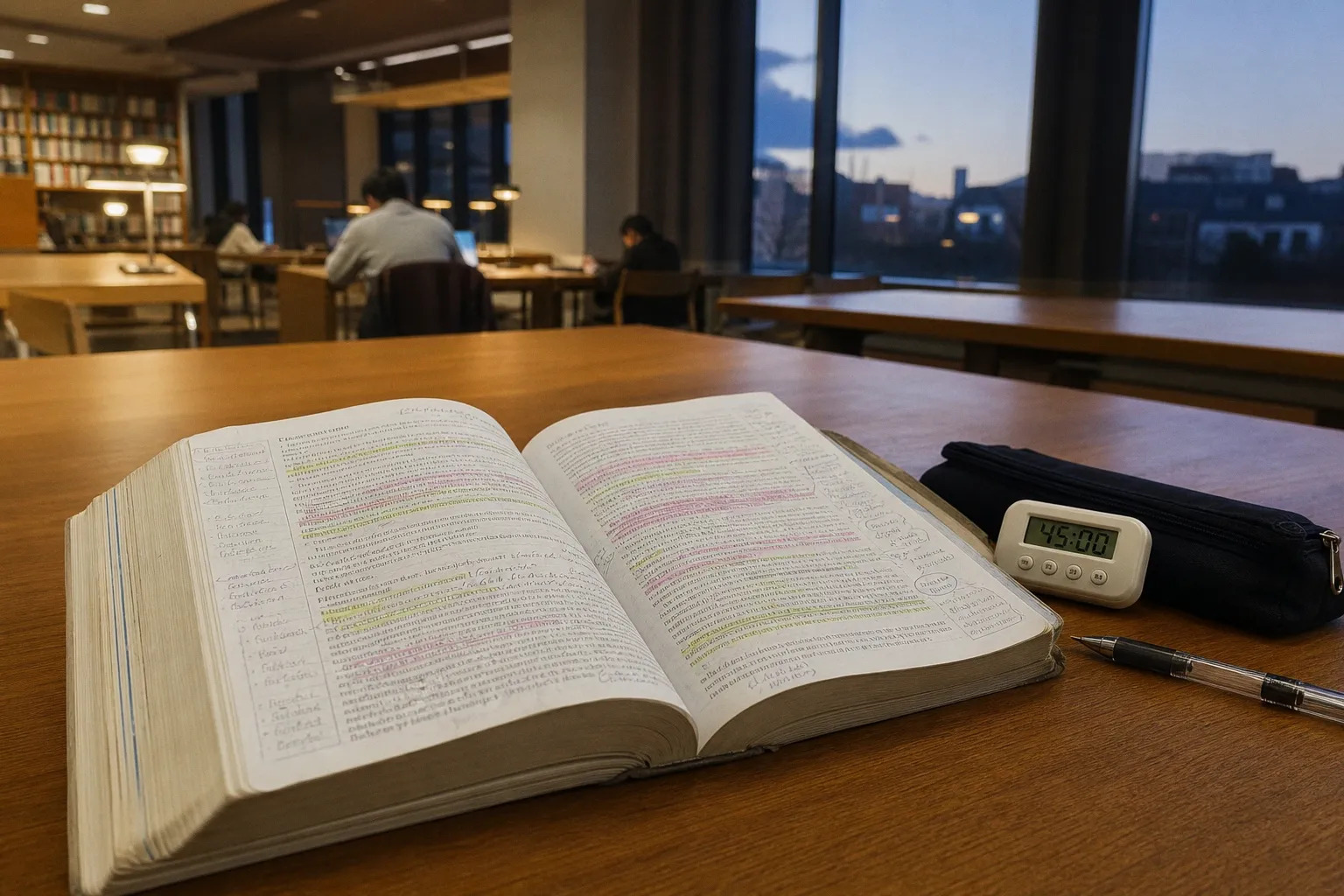
IELTS preparation book: core features and study mechanics
The book you pick will shape how you train for a test that takes just under three hours yet often decides whether you walk into your first university lecture, your visa appointment, or your new job. Keep in mind that the best preparation book is not the thickest one or the one with the flashiest cover — it's the one whose structure mirrors what you'll face on test day and supports the way you actually study.
Anatomy of an effective IELTS study guide
What separates a genuinely useful IELTS preparation book from a glorified vocabulary list? Essentially, it comes down to four pillars working together: authentic-format practice, clear answer keys with model responses, explanations of scoring criteria, and audio or transcripts for Listening. If a book is missing any one of these pillars, your study routine will develop a blind spot — and on test day, blind spots show up as lost band points.
A well-built study guide divides its content by the same logic the test uses. IELTS has four sections — Listening, Reading, Writing, and Speaking — and your book should treat them as four distinct training grounds rather than a single undifferentiated block. It also needs to specify which test version it supports. Listening and Speaking are identical in IELTS Academic and IELTS General Training, but Reading and Writing materials differ between the two. If you're aiming for university admission, you need Academic; if you're applying for work experience or certain immigration routes, General Training may be the right path. Keep in mind that a book promising "complete IELTS preparation" while showing only one version is, for your purposes, incomplete.
Beyond test version, a strong book is organised by skill and question type. This sounds obvious, but it matters: practising matching headings in Reading is not the same as practising true/false/not given, even though both appear in the same section. Each question type has its own reading strategy, time pressure, and trap. A book that lumps them together without separating them is essentially asking you to figure out the differences on your own, which is exactly the buffer you bought the book to avoid.
Finally, every effective IELTS workbook includes full-length practice tests that you can take under timed conditions. This isn't an optional extra — it's where your stamina, pacing, and psychological readiness get built. A book that offers only short drills and no full tests will leave you underprepared for the reality of sitting through 2 hours and 45 minutes of continuous testing.
A good IELTS preparation book mirrors the test itself: section by section, timed condition by timed condition, with answers you can actually learn from.
Mastering the Listening and Reading mechanics
Listening and Reading are the two sections where most candidates expect to perform well — and where preparation books earn or lose their credibility. Each section has very specific mechanics that a useful book must teach, not just drill.
Let's start with Listening. The section runs for about 30 minutes, contains four parts and 40 questions, and the recordings are played only once. The audio features a mix of British, Australian, New Zealand, and North American accents, which means you cannot prepare your ear for a single accent. If a preparation book provides only written transcripts without accompanying audio, it cannot train the skill that actually gets tested. Look for a book with CDs, downloadable audio, or an app companion — anything that lets you hear the recording played once while you answer.
Then comes the transfer step. For paper-based Listening, you get an extra 10 minutes after the recording ends to copy your answers onto the answer sheet. Keep in mind that incorrect spelling or a missed word limit can cost you marks even when your answer was technically right. A useful preparation book includes answer-sheet practice and reminds you to check spelling, plurals, and grammar. Some editions also cover Listening on computer or IELTS Online — make sure the version matches your planned test mode, because the interface differs in subtle but important ways.
Reading works on tighter mechanics. Academic Reading has three sections, 40 questions, and 60 minutes total — and crucially, that 60 minutes already includes the time to transfer your answers. There's no extra buffer at the end. The total word count across the three passages runs from 2,150 to 2,750 words, which means you're reading roughly 2,500 words under real time pressure. An IELTS workbook that includes realistic passage lengths and strict timing will teach you the most important lesson in Reading: when to move on. If you spend 25 minutes on the first passage, you're not being thorough — you're budgeting failure into the second and third.
If/Then scenarios help here. If your target band is 7.0 overall but you're stuck at 6.0 in Reading, a book with detailed answer explanations and timing strategies will do more for you than one packed with extra passages. The first book teaches you how to extract the right answer under pressure; the second just gives you more chances to miss it the same way.
Decoding Writing criteria and model responses
Writing is where preparation books most often fall short. They hand you prompts, give you a sample essay, and assume you'll figure out the difference between a band 6 and a band 8 on your own. That's not how band scores work, and it's not what peace of mind on test day feels like.
IELTS Writing is assessed using four criteria, and every solid preparation book should name them clearly: Task Achievement (or Task Response, in Task 2), Coherence and Cohesion, Lexical Resource, and Grammatical Range and Accuracy. These four criteria are not interchangeable. A book that explains them with annotated model answers — where each criterion is highlighted and commented on — gives you a measurable target. A book that just publishes model essays without commentary gives you text to admire, not skills to build.
Now the mechanics. Academic Writing gives you 60 minutes for two compulsory tasks. Task 1 requires at least 150 words and should take around 20 minutes; Task 2 requires at least 250 words and should take around 40 minutes. Task 2 contributes twice as much as Task 1 to your Writing score, which means Task 2 is not just "the longer essay" — it's the essay that carries the section. A preparation book that treats the two tasks as equally weighted is misleading you by structure. A book that devotes roughly twice as many model responses, prompts, and criterion explanations to Task 2 is giving you a realistic picture of where your study time needs to go.
Here's a useful comparison to keep in mind:
| Feature | Academic Writing Task 1 | Academic Writing Task 2 |
|---|---|---|
| Minimum word count | 150 | 250 |
| Suggested time | ~20 minutes | ~40 minutes |
| Weight in Writing score | x1 | x2 |
| Typical input | Visual (graph, chart, diagram, process) | Essay prompt with opinion, argument, or problem |
| Core focus | Describing and summarising key features, comparing data | Presenting and supporting a position, structuring an argument |
A preparation book with this kind of clear breakdown — task by task, weight by weight, focus by focus — becomes a study planner, not just a content dump.
Structuring Speaking practice for high band scores
Speaking is the section where preparation books are most often underestimated. The reasoning goes something like this: "Speaking is conversational, so I'll just talk to people." But the test has a structure, and structure is what a book can teach.
Speaking lasts 11 to 14 minutes and is split into three parts. Part 1 runs about 4 to 5 minutes and covers familiar topics like studies, work, hometown, or daily routines. Part 2 takes 3 to 4 minutes total, including one minute of preparation time, and asks you to speak for up to two minutes on a task card topic. Part 3 runs about 4 to 5 minutes and dives deeper into abstract issues connected to the Part 2 topic. The three parts are scored together against the same four criteria — Fluency and Coherence, Lexical Resource, Grammatical Range and Accuracy, and Pronunciation — which means ignoring any one of them is ignoring a third of the surface area examiners will sample.
Keep in mind that the one-minute preparation window in Part 2 is not a thinking pause — it's a planning window. A strong IELTS preparation book will give you task cards and walk you through how to use that minute: jotting down a structure, marking two or three points to cover, picking a few topic-specific vocabulary items, and timing your delivery. Without this kind of framework, most candidates ramble for 60 seconds and run out of content for the remaining minute.
A book that supports Speaking practice well includes three things: a library of task cards covering all three parts, a timer or timing guidance, and a method for self-review or feedback. Recorded self-review is especially useful — listening back to your own two-minute response exposes filler words, hesitation patterns, and grammar slips that feel invisible in the moment. Some books include audio prompts played in an examiner-like voice; others provide transcripts of model answers. Both can work, as long as you have a way to measure your output against a target.
The other thing to navigate is accent and pronunciation expectations. IELTS examiners are trained to understand a wide range of English accents, so the test is not about sounding British, American, or Australian. It's about clarity, stress patterns, and the rhythm of connected speech. A book that addresses these features — intonation, sentence stress, weak forms — gives you a more useful toolkit than one that simply provides model monologues.
Speaking practice without a timer, a task card, and a way to review yourself is just talking — useful, but not IELTS preparation.
Integrating timed practice into your study routine
Even the best IELTS preparation book won't help much if you read it like a novel. The mechanics of the test require mechanics of study — and that means building a routine around timed conditions, not around page counts.
A practical routine looks something like this. Pick a test date, work backwards, and divide your weeks into phases. The first phase is format familiarisation: work through each section slowly, learning the question types, timing rules, and scoring criteria. The second phase is skill building: drill the question types that confuse you, study the model responses in Writing, and listen to the audio in Listening repeatedly. The third phase is full-test simulation: take complete practice tests under real timing, including the 10-minute answer transfer on paper Listening, the 60-minute Reading window with no extra buffer, and the 11-to-14-minute Speaking window.
If you study for an hour a day, three days a week, you'll likely want at least 6 to 8 weeks to cover all three phases meaningfully. If your test is sooner than that, focus on full-test practice and the highest-weight tasks first — that's Task 2 in Writing, which counts for twice as much as Task 1 in the Writing band, and balanced rehearsal across all three Speaking parts, since the same four band-score criteria apply to each one and an examiner will sample all three.
A useful preparation book helps you navigate this routine by including diagnostic tests, progress checks, and band-score predictors. Some books have online components or score calculators that estimate your current band based on practice-test results. Keep in mind that these predictions are estimates, not guarantees, but they give you a buffer of awareness: if your simulated Reading score is consistently 6.5 but your target is 7.5, you know exactly where to focus the next two weeks of study.
Here are the features that turn a book from content into a self-study prep book:
- Authentic-format Listening audio with a mix of accents
- Academic or General Training materials clearly labelled and matched to your test version
- Answer keys with explanations, not just letter answers
- Model responses for Writing annotated against the four criteria
- Speaking task cards covering all three parts, with timing guidance and review methods
- At least two full-length practice tests with timing instructions
- Score-band descriptors or self-assessment tools
- Format compatibility with your planned test mode (paper, computer, or online)
If your book ticks most of these boxes, it's built to do the job. If it's missing two or three, you'll end up supplementing with free online resources — which is fine, but it means the book isn't doing what you paid it to do.
Final thought
An IELTS preparation book is, at its best, a structured rehearsal space for test day. It teaches you the section mechanics — roughly 30 minutes of Listening with a single audio playback, 60 minutes of Reading with no extra transfer time, 60 minutes of Writing weighted heavily toward Task 2, 11 to 14 minutes of Speaking with a one-minute planning window and three parts scored against a single set of criteria. It also teaches you how the four sections combine into an overall band score, which is the average of your four component scores, rounded to the nearest half band. Knowing this arithmetic is itself a form of peace of mind: you can see, with real numbers, which skill deserves your next week of focused practice.
Keep in mind that no single book — no matter how well-reviewed or how expensive — can promise a specific band. The unknowns are real, and the test has variables no book controls. What a good book can promise is structure, authentic practice, clear explanations, and the materials to train each skill against the criteria that examiners actually use. That's not everything, but it's the foundation. With that foundation in place, your study hours stop being guesswork and start being preparation.