Fully funded scholarship checklist for international students
You have decided to chase a fully funded scholarship, and the inbox is already filling with deadline reminders, program brochures, and conflicting advice from older cousins. The paperwork feels heavier than the dream.
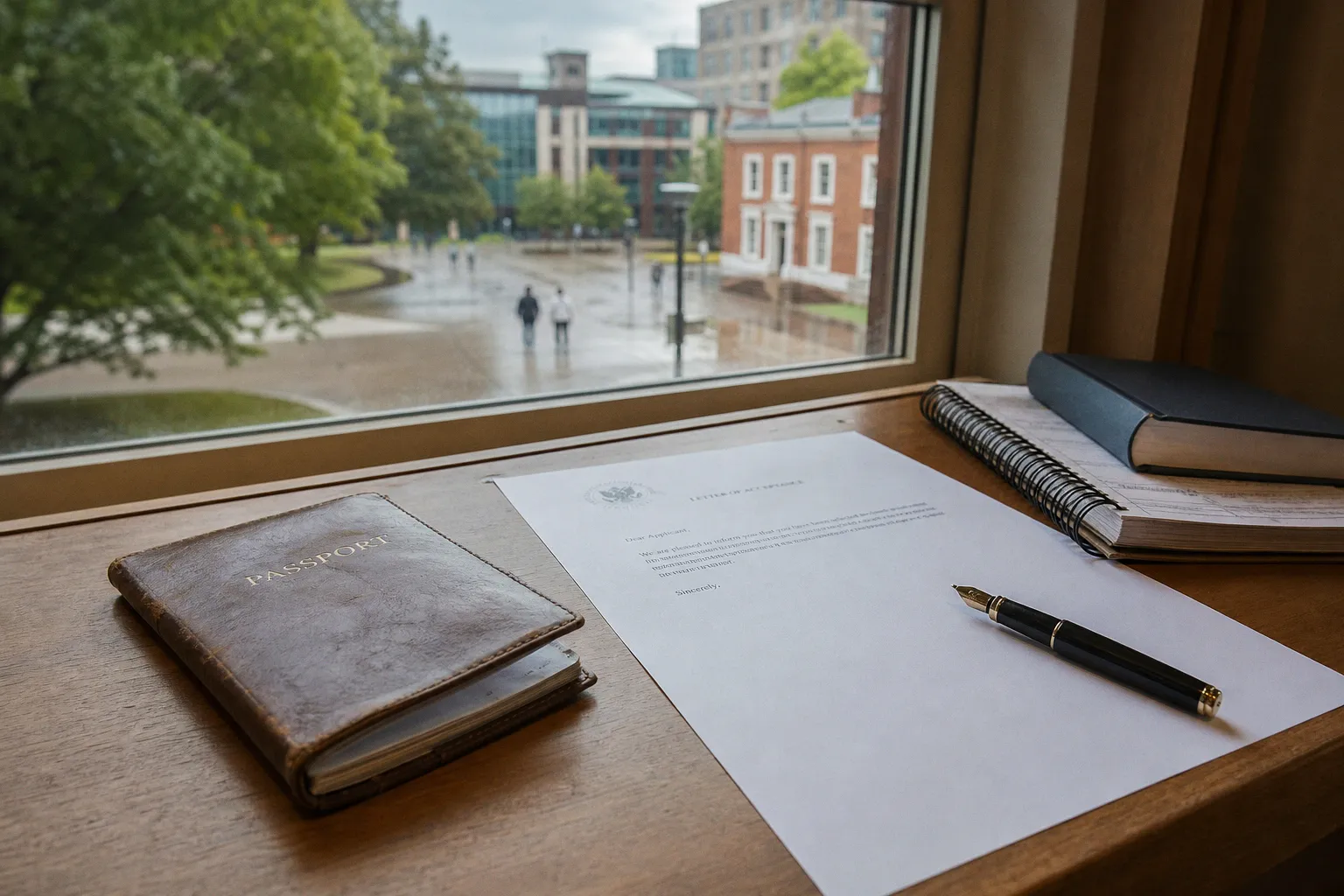
This guide walks you through the entire checklist, in the order you actually need to handle it. Keep in mind that most students underestimate the timeline and overestimate their readiness, so we have built in a buffer at every stage to give you peace of mind when the deadline inevitably moves faster than you expect.
A fully funded scholarship rewards organized applicants. The award almost always goes to the student who treats the process like a 12-to-18-month project, not the one who panics in the final week.
The 18-month strategic timeline for scholarship success
The single biggest mistake applicants make is treating the scholarship as a single task with a single due date. In reality, a fully funded master's scholarship — the kind that covers tuition, monthly stipends, health insurance, and sometimes even travel — is closer to a project with five overlapping phases. Programs like the DAAD EPOS, the Chevening Scholarship, the Fulbright grant, and most government-funded awards operate on intake cycles that open 9 to 12 months before the start of the academic year. If you want to study in Germany in October 2027, your scholarship portal typically closes between October 2025 and January 2027, depending on the program.
Working backwards from your target intake, here is the rhythm that experienced applicants follow:
- 18 months out: Choose your programs and confirm eligibility. This is the strategic phase, not the paperwork phase. Pin down two to four scholarships that match your profile, your field, and your nationality eligibility. If a scholarship is restricted to specific countries, applicants from developing economies, or particular professional sectors, that filter saves you weeks of wasted essays.
- 12 months out: Start gathering official documents. Request official academic transcripts, degree certificates, and certified copies of your passport. If your documents are not in English or German, you will need certified translations from an authorized translation service — this step alone can take six to eight weeks, so it belongs near the front of the timeline.
- 9 months out: Begin drafting your motivation letter and any research proposal. Most programs cap the motivation letter at two pages, which means every paragraph has to earn its place. Drafting early lets you revise with a clear head rather than at 2 a.m. the night before submission.
- 6 months out: Take or retake your language test. IELTS Academic and TOEFL iBT seats fill up fast in spring and autumn. Booking early lets you pick a date where you can actually perform well, with a buffer for a retake if your first score falls short.
- 4 to 6 months out: Request recommendation letters. Email your referees at least four to six weeks before the deadline. A rushed professor writes a generic letter, and a generic letter is the fastest way to lose an interview slot.
- 2 to 3 months out: Collect supporting clearances. Some government scholarships require a medical certificate, a police clearance certificate, or proof of professional experience verified on official letterhead with signatures and stamps. These documents travel through bureaucratic offices, so assume a buffer of six to eight weeks.
- Final month: Assemble, proofread, and submit. Print the checklist, verify each line, and upload everything at least 48 hours before the deadline. Server crashes during the final 24 hours are more common than you would think.
If you only remember one thing from this section, keep in mind that the 18-month timeline is not a suggestion — it is the difference between a clean, confident application and a frantic, incomplete one.
Essential academic and professional documentation standards
Once the timeline is set, the next layer is the document foundation. Scholarship committees read hundreds of files per cycle, and a missing or non-standard document is the most common reason an otherwise strong candidate gets filtered out automatically. You want your file to look professional from the first page, which means understanding exactly what each program expects.
For most European programs, your academic CV should follow the Europass format — a standardized template recognized across the EU that organizes your education, work experience, languages, and digital skills in a clean, scannable structure. If you are applying to U.S., U.K., Canadian, or Australian programs, a traditional academic CV (one to two pages, reverse chronological) is generally acceptable, but always cross-check the program's specific instructions. Some institutions reject CVs that exceed two pages, while others expect a longer academic CV with publications and conference presentations.
Your academic documents — transcripts, diplomas, and degree certificates — must be:
- Issued in the original language, with certified translations if the original is not in English or German.
- Stamped and signed by the issuing institution. A printout from a student portal is not an official transcript.
- Sealed in an envelope if the program requires mailed documents. Most scholarships accept uploaded scans, but some still require the physical sealed envelope, so read the instructions carefully.
For professional experience, keep in mind that fully funded scholarships like the DAAD EPOS and the Helmut-Schmidt Programme explicitly require a minimum of two years of relevant, post-graduation, full-time professional experience. Internships and part-time work, even if substantial, do not always count toward this requirement. Your employer will need to verify this experience on official letterhead, with a stamp, a signature, and a clear description of your role, your responsibilities, and your employment dates. If you are self-employed, you will typically need tax documents, business registration certificates, and reference letters from clients.
Here is a quick reference for the core documentation layer:
| Document | What committees expect | Typical timeline to prepare |
|---|---|---|
| Academic CV | Europass format (EU programs) or 1–2 page academic CV | 1–2 weeks to draft, longer to refine |
| Motivation letter | 2 pages maximum, program-specific | 4–6 weeks with revisions |
| Official transcripts | Certified, sealed, with translations if needed | 6–8 weeks including translation |
| Degree certificates | Original language + certified translation | 4–6 weeks |
| Professional experience letters | Official letterhead, signature, stamp, dates | 2–4 weeks from employer |
| Passport copy | Valid for at least 6 months beyond program end date | Immediate |
If any of these documents feel unfamiliar or hard to obtain, treat that as your first warning sign. The earlier you flag a documentation gap, the more time you have to find a workaround — whether that means requesting an unofficial transcript while waiting for the official one, or asking your university registrar about expedited processing.
Navigating language proficiency and standardized testing benchmarks
The language test is the part of the application where most students either float or sink, often because they underestimate how long the preparation cycle takes. If English is not your first language, you will almost certainly need to prove proficiency through IELTS Academic or TOEFL iBT, and the benchmark most fully funded scholarships expect is an IELTS Academic score of 6.5 or above, or a TOEFL iBT score of 90 or above. Some competitive programs, particularly in the U.K. and Australia, push that benchmark higher to 7.0 or 100.
Here is the part that saves applicants from a wasted test fee: some programs waive the language requirement entirely if your previous degree was taught entirely in English. This waiver is not automatic — you usually need a formal letter from your university confirming the medium of instruction, signed and stamped on official letterhead. If you graduated from an English-medium university and never sat IELTS, do not assume you are exempt. Confirm with the scholarship secretariat before skipping the test.
If you do need to sit the test, treat it as a 10-to-12-week project, not a weekend cramming session. The most reliable path looks like this:
1. Book the test date 8 to 12 weeks ahead. Test centers in major cities fill up fast, especially during October–December and March–May admission cycles.
2. Take a diagnostic test in week one. This tells you whether you need to focus on reading speed, writing structure, listening accuracy, or speaking fluency.
3. Build a six-week study plan. Most successful applicants spend 1 to 2 hours per day on focused practice, with one full mock test per week.
4. Take the real test in week eight. Leave a buffer of two to four weeks for a retake if your first score falls short of the benchmark.
5. Send official scores directly from the test center. Most scholarship portals will not accept a screenshot of your results page — they want the institutional report sent by IELTS or ETS.
Keep in mind that some programs accept alternative tests, including PTE Academic, Duolingo English Test, or Cambridge C1/C2. The acceptance list varies by year and by institution, so always check the current call for applications before booking. And if your target program is in a non-English-speaking country — Germany, France, the Netherlands, the Nordics — you may also need to demonstrate proficiency in the local language, even if the master's program itself is taught in English. A basic A1 or A2 certificate is sometimes required for the visa and residence permit, not for the academic admission, which is a distinction that catches many applicants off guard.
Crafting high-impact motivation letters and research proposals
If the documents are the bones of your application, the motivation letter is the voice. This is where you explain, in your own words, why you deserve the seat and what you plan to do with the degree after graduation. A weak motivation letter reads like a recycled template; a strong one tells a specific story that the committee could not get anywhere else.
For most master's scholarships, the motivation letter is capped at two pages, single-spaced, in a 11 or 12 point font. That is roughly 800 to 1,000 words, which means you do not have room for filler. Every paragraph should answer a clear question:
- Paragraph 1: Your current trajectory. What are you working on right now, and why does the next academic step make sense?
- Paragraph 2: Why this program, specifically. Name professors, courses, research centers, or partnerships that align with your goals. Generic praise ("your university is prestigious") signals that you wrote the letter for ten different scholarships.
- Paragraph 3: What you will contribute. Scholarship committees fund future leaders, not just future students. What will you bring to the cohort, and what impact will you create after graduation?
- Paragraph 4: How the scholarship changes your trajectory. If you needed to self-fund, would the degree still happen? If not, explain honestly how the funding unlocks a path that would otherwise stay closed.
If your program is research-based — a PhD, a research master's, or a structured track within a taught program — you will also need a research proposal that outlines your research question, methodology, expected outcomes, and the broader contribution to your field. A research proposal is not a polished academic paper. It is a working document that shows you have thought seriously about what you want to investigate, why it matters, and how you plan to investigate it within the program's timeframe.
Here is a useful If/Then approach that experienced applicants use: If the program emphasizes professional development, then your motivation letter should highlight leadership experience and post-graduation career plans. If the program emphasizes academic research, then your motivation letter should emphasize research interests and academic mentors you want to work with. Misreading the emphasis is one of the most common reasons a strong candidate gets shortlisted but not awarded.
Securing strong recommendations and administrative clearances
The final layer of the checklist is the one most applicants leave until the last minute — and then scramble to assemble. Letters of recommendation and administrative clearances look simple on paper, but each one moves through someone else's hands, which means each one carries a delay you cannot fully control.
Most international scholarships require two to three letters of recommendation, typically from:
- Academic referees — professors, thesis supervisors, or lecturers who can speak to your intellectual ability and academic readiness.
- Professional referees — employers, supervisors, or mentors who can speak to your work ethic, leadership, and professional growth.
- Optional character referees — coaches, community leaders, or volunteer coordinators, used sparingly to round out your profile.
The single most important rule is to request the letter at least four to six weeks before the deadline, in person if possible, with a follow-up email summarizing the deadline, the submission portal, and any specific points you would like the referee to address. A referee who feels respected and well-informed writes a letter that feels personal. A referee who feels rushed writes a letter that feels generic, and a generic letter is the same as no letter at all.
Administrative clearances are the other sleeper task. Some government-funded scholarships — particularly those tied to bilateral agreements between countries — require:
- A medical certificate confirming you are fit to study abroad, usually issued by a recognized hospital or clinic.
- A police clearance certificate confirming no criminal record, issued by your national police authority.
- A copy of a valid passport, with at least six months of validity beyond the program's end date. If your passport expires within that window, renew it before you start the application, not after.
These documents do not arrive overnight. A police clearance can take three to six weeks depending on the country, and a medical certificate may require multiple appointments, vaccinations, or lab tests. Build them into the timeline the same way you build in the language test, and treat each one as a non-negotiable checkpoint.
If a referee does not respond within two weeks of your request, follow up politely, then escalate to a backup referee. Waiting until the deadline to chase a missing letter is the fastest way to disqualify yourself.
Putting the full checklist together
When you zoom out, the fully funded scholarship checklist is essentially a layered system: a timeline, a document foundation, a language verification, a personal narrative, and a referee network. None of these layers stand alone. A perfect motivation letter cannot save a missing transcript. A high IELTS score cannot compensate for a recommendation letter that was written in twenty minutes. The award goes to applicants who respect every layer, in order, with enough buffer to handle the inevitable delays.
Use this final checklist as your closing filter before you hit submit:
- Timeline reviewed: 18 months of milestones mapped backwards from your target intake.
- Documents certified: Transcripts, degree certificates, and translations stamped and sealed.
- Professional experience verified: Employer letters on official letterhead with signature and stamp, covering at least two years of full-time, post-graduation work where required.
- Language test scheduled or waived: IELTS 6.5+, TOEFL iBT 90+, or a formal medium-of-instruction waiver on file.
- Motivation letter program-specific: 2 pages maximum, written for this scholarship, not a template.
- Research proposal drafted: Research question, methodology, and outcomes clearly defined if applying to a research program.
- Recommendation letters requested: Four to six weeks of lead time, two to three referees confirmed.
- Clearances underway: Medical certificate, police clearance, and passport validity all checked and dated.
- Submission completed: All files uploaded at least 48 hours before the deadline, with a final proofread pass on every document.
A fully funded scholarship is, at its core, an invitation to prove that you are ready. The award is generous because the committee believes in your trajectory. Treat every document, every letter, and every deadline as a chance to show that belief is well placed, and the rest of the process tends to take care of itself.